
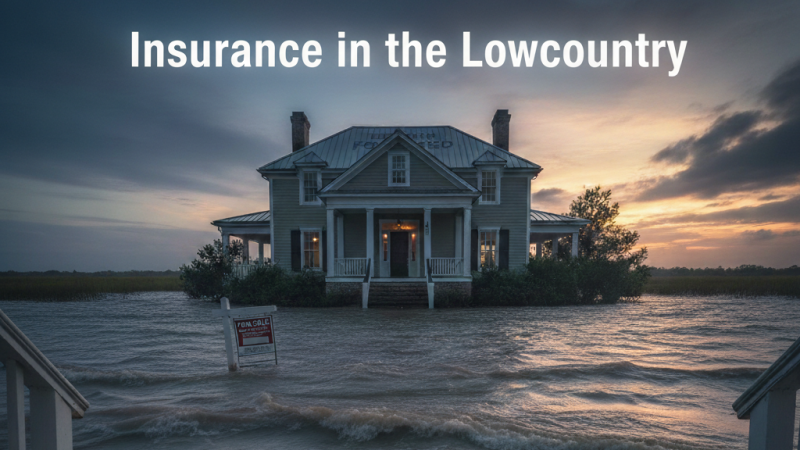
The future of the Lowcountry is currently being debated in the halls of the State House and along the rising edges of the Charleston peninsula. As of February 2026, the legislative centerpiece of this effort is the Insurance Rate Reduction and Policyholder Protection Act (H. 4817). Introduced in January, this bill aims to stabilize the market by aggressively targeting insurance fraud—specifically in roofing scams—and increasing the premium tax revenue diverted to the SC Safe Home grant program from 1% to 5% (SC Revenue and Fiscal Affairs Office 2026). By hardening the “SC Safe Home” fund with an estimated $10 million in additional annual revenue, the state hopes to lure private carriers back to the coast, betting that a more resilient housing stock will reduce the catastrophic risk that has caused many providers to flee (Western Upstate Association of REALTORS 2026 Watchdog Report).
However, even with legislative intervention, a “climate discount” has begun to appear in local real estate data. For many prospective buyers, high insurance premiums are now functioning as a “shadow mortgage,” effectively reducing the borrowing power of residents and, by extension, the resale value of homes in high-risk zones. Recent analysis indicates that homes in the most catastrophe-exposed ZIP codes have seen their underlying values drop significantly compared to inland counterparts as buyers factor in the permanent, non-negotiable cost of flood and wind coverage (National Bureau of Economic Research 2026; Partners in Financial Planning). This shift is creating a bifurcated market where “high-ground” properties maintain their premium status, while “pre-FIRM” homes at lower elevations face a “valuation ceiling” imposed by the skyrocketing cost of ownership (Century 21 Charleston Real Estate 2026).+1
To combat this erosion of value, local municipalities are doubling down on massive infrastructure projects. In Charleston, the Peninsula Perimeter Protection Project took a definitive step forward in late 2025 with a signed agreement between the city and the U.S. Army Corps of Engineers to begin the preconstruction and design phase of an eight-mile seawall (U.S. Army Corps of Engineers 2025/2026 PED Agreement). These “grey infrastructure” defenses, paired with “Living With Water” drainage improvements like the Spring/Fishburne pump stations, are designed to protect the tax base and preserve the long-term insurability of the city’s most historic assets (City of Charleston Project Dashboard 2026). While some communities are beginning to discuss “managed retreat”—the strategic relocation of structures away from chronic flood zones—the Lowcountry’s current strategy remains focused on “fortifying the edge” (Georgetown Climate Center 2026).
Conclusion
The Lowcountry of 2026 is a region in transition, where the price of the view now includes the cost of the defense. Through a combination of state-funded retrofits, aggressive legislative reform, and billion-dollar sea walls, South Carolina is attempting to outpace the rising tides of the global insurance market. For the homeowner, the message of this series is clear: affordability in the Lowcountry now depends on proactive participation in resilience. Whether it is applying for an H. 4817-funded grant or choosing a home based on its elevation rather than its aesthetic, the survivors of this new coastal economy will be those who treat insurance not as a passive bill, but as a strategic frontier of homeownership.
Ultimately, the Lowcountry of 2026 is a region in a state of recalibration, where the historic charm of coastal living is being weighed against the new, high-precision math of climate risk. While the era of “frenzy” buying has transitioned into a more balanced market, the true cost of homeownership now includes an actuarial premium that acts as a permanent “shadow mortgage” on coastal equity (Southern Bell Living 2026; Realtor.com Forecast). The future of this landscape will likely be defined by a growing divide: between those who have modernized their homes to meet the FORTIFIED™ and “code-plus” standards required by private markets, and those remaining in high-risk zones where insurance subsidies continue to vanish under FEMA’s Risk Rating 2.0 (FEMA 2026 Profile; Smart Home America).
The resilience of South Carolina’s coast will not be won through hope alone, but through the aggressive implementation of the Insurance Rate Reduction and Policyholder Protection Act and the billion-dollar infrastructure projects now breaking ground in cities like Charleston (SC Revenue and Fiscal Affairs 2026; City of Charleston Dashboard). For the long-term resident, the path forward is clear: affordability is no longer a passive state, but an active pursuit involving mitigation grants, strategic elevation, and an eyes-wide-open approach to the evolving financial climate. As we look toward the 2030s, the Lowcountry remains one of the nation’s most desirable “hot spots,” but its survivors will be those who recognize that a home is more than an investment—it is a fortress that must be built to withstand both the rising sea and the rising costs of the market (NAR 2026 Hot Spots; NBER 2026).